Monday, January 5, 2009

Course E-Mail Netiquette

Here are the points of e-mail protocol for our course :

  1. E-mail (indeed, all communication) between Lecturer and student, and TA and student, is a formal and professional exchange. Accordingly, proper salutation and closing is essential.
  2. Business e-mail is courteous but, of professional necessity, concise and direct. It rejects roundabout or ornate language, informal diction, and any appearance of what is termed in the vernacular, 'chat.'
  3. Customary response time for student e-mail to the Course Lecturer or TAs is two to three office days. E-mail on weekends will ordinarily be read the Monday following.
  4. Use only your SFU account for e-mail to the course Lecturer. All other e-mail is blocked by whitelist.
In general, Course e-mail is for matters of Course administration solely. It is not an alternative to, nor substitute for, Office Hours or Tutorial. All questions about understanding of lecture material, course reading, assignment criteria, and deadlines are reserved for Tutorial and Office Hours.

Missed classes and deadlines are not to be reported by e-mail: if a medical or bereavement exception is being claimed, the supporting documentation is handed in, along with the completed assignment, either in person or to the Instructor's mailbox outside the Department Office.

Essay Grading

The assignment grading criteria used by the SFU English Department are available online here. The relationship between the letter grades and the percentages is as follows:
A+ 96-100
A 90-95
A- 85-89
B+ 80-84
B 75-79
B- 70-74
C+ 65-69
C 60-64
C- 55-59
D 50-54
F 0-49
N
Incomplete
DE Deferred

Course Outline

ENGLISH 340 D1.00
STUDIES IN 20TH-CENTURY BRITISH LITERATURE BEFORE 1945
Instructor: S. OGDEN
SPRING 2009
Rats, Gas & Shell-Shock: the Literary Scars of WWI

The success of contemporary British novelist Pat Barker's 1990s Regeneration trilogy and its subsequent film adaptation has opened new interest in World War One and indicates that Britain may at last be ready to confront the full atrocity of that unnecessary, unfinished and unconscionably mismanaged war. So unbearable were life and death alike in trench warfare that works of imagination in Britain struggled to face its full horrors squarely. Indeed, the literary history of 20th Century Britain to 1945 - including works as diverse as Lady Chatterley's Lover and Lord of the Rings - is traceably scarred by festering wounds of the "War to End all Wars." In this course we will read and examine several now-neglected masterpieces by important British writers of the period, and see how each in its own artistic terms both succeeds and fails to respond adequately the (perhaps literally) unspeakable horrors of the trenches. We will look too at a few of the great First World War poets, including Sassoon and Owen, who, writing as they did from front-line experience, more immediately recorded those terrors, like gas warfare and shell shock, not even named before their devastation was accomplished.

NOTE: The BBC comedy series Blackadder Goes Forth, set in World War One, will be seen in clips throughout the course to give dramatic background and satiric analysis of the events. Testimony to the unresolved status of World War One in Britain, laughter turned to cathartic sorrow when first broadcast of the series' poignant conclusion produced national weeping.

REQUIRED TEXTS:

West, Rebecca The Return of the Soldier 0-14-118065-X Penguin
Forester, C. S. The General 1-87785339-9 Nautical & Aviation
Ford, Maddox F. Parade's End 0-14-118661-5 Penguin
Woolf, Virginia Jacob's Room 0-14-018570-4 Penguin
Waugh, Evelyn Vile Bodies 0-316-92611-6 Black Bay

Recommended Text:

Silkin, John, ed. First World War Poetry 0-14-118009-9 Penguin

The following texts will be placed on reserve in the library: Women's Fiction & the Great War by Raitt & Tate; Regeneration by P. Barker; The Great War in British Literature by A. Barlow; The War in the Trenches by A. Lloyd.

COURSE REQUIREMENTS:

10% Productive participation
20% Mid-term paper (approx. 2000 words)
30% Group field assignment
40% Final paper (approx. 3500 words)

Saturday, April 7, 2007

"The Great War" on Canadian State Television

Our State TV network has a two-part show on WWI: The Great War: first broadcast April 14 2007, and with the son of former Prime Minister Pierre Trudeau as one of the actors.
On the other side of the Statist-Private divide, in 2008 Canadian actor Paul Gross privately financed and produced the major film Passchendaele. This patriotic work (in Orwell's sense of partiotism as favourably distinguished from nationalism) did not feature any offspring of former Prime Ministers....

Tuesday, April 3, 2007

Canadian High School Students at Vimy Ridge

From canada.com:

Vimy: Students arrive in France today.
Each will carry the memory of a Canadian soldier.
Tony Atherton, CanWest News ServicePublished: Tuesday,
April 03, 2007
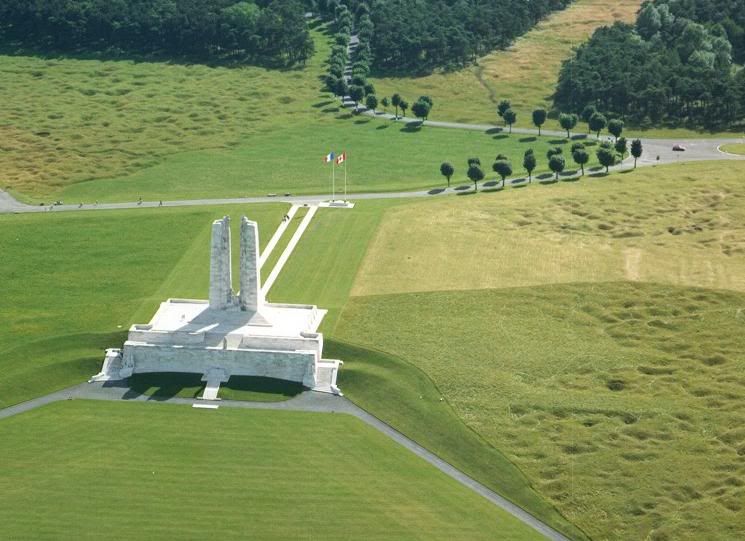
OTTAWA -- On Easter Monday in northwest France, a crowd of 25,000 is expected to gather on the long, broad green in front of the Vimy Memorial. It may be the biggest gathering in the Douais region of Picardie since King Edward VIII dedicated the heart-stirring monument 71 years ago. That number of people, coincidentally, is the same as the number of Canadian soldiers who surged out of tunnels and trenches on April 9, 1917, and over the fortified ridge on which the memorial now stands ....
Beginning Wednesday, through newspaper stories, photographs and in their own online blogs, these six teenagers will let readers back home peek over their shoulders as they marvel at the sights of Paris and bow their heads over the graves of Flanders. As their journey progresses, each will strive to learn a little more about the soldier for whom their act of deliberate remembrance is a kind of living memorial.

Jessica Mitford: edited Letters

An illuminative review at Slate.com on a new collection of Jessica Mitford's letters, edited under the title Decca
Although it is not uncommon for big families to produce a rebel or two along with the chip-off-the-old-block offspring, there are few that can lay claim to as much dissension within the ranks as the aristocratic clan of Mitford. This gaggle of wayward sisters (six in all, with one brother, Tom, who was killed in combat in 1945 at the age of 36) included Diana, the family beauty, who married the dastardly Oswald Mosley, head of the British Fascist party; Nancy, the family wit, whose novel The Pursuit of Love kick-started the proliferation of novels, memoirs, and biographies that would come to be called the Mitford "industry"; and the family madwoman, Unity, who went bonkers for Adolf Hitler and put a pistol to her head when Britain declared war on Germany.

Monday, April 2, 2007

'No More Tories" -- the very last Tory

When Madox Ford named Christopher Tietjens "the last Tory" he meant that, as a consequence of World War I, the Tory way of thinking is now completely impossible. Evidence supporting this claim can be found in this New English Review article, published today, from a writer who is as close to being a Tory as would be possible in a post-Tory world: the ex-patriot Englishman in America, Mr John Derbyshire.
Using the facts of the behavior of the complement of English sailors taken capture by the Iranians, Deryshire's article demonstrates the very argument it is making: that Tory Englishness is utterly dead in the world today, even where formerly it was most evident.